Introduction
A garden waterfall does something most landscaping features can't: it adds sound, movement, and a natural focal point all at once. Done right, it transforms an ordinary backyard into a space that feels intentional—a place you actually want to spend time in.
Yet many homeowners in Marietta and the greater Atlanta area want exactly this—and aren't sure where to start. Which style fits a suburban lot? And what does it take to build something that holds up in Georgia's heat and humidity?
This guide covers the main types of pond waterfalls and spillways, design ideas organized by garden style, essential planning considerations, and what it takes to bring a vision to life in a Georgia garden.
TLDR:
- Waterfalls involve elevation change and flowing water; spillways are the lip or channel that controls the drop
- Pondless systems lead in popularity for suburban yards due to safety and lower maintenance
- Georgia's climate supports lush plantings but requires careful pump sizing and filtration
- Costs range from $4,000–$10,000 for pondless features; traditional ponds with waterfalls start around $3,400
- Proper planning prevents the most common failures: leaks, water loss, and algae overgrowth
Types of Pond Waterfalls and Spillways for Garden Spaces
A pond waterfall involves elevation change—water flows over rocks or a structure and collects in a basin below. A spillway (also called a weir) is the lip or channel where water begins its drop, controlling both flow volume and sound. While a fountain recirculates water in place, a waterfall requires height and gravity to create its signature cascade.
Naturalistic Rock Waterfalls
This is the most popular style in residential gardens across the Southeast. Stacked fieldstone or boulders are arranged to mimic a natural cascade, with water trickling over irregular surfaces and pooling below. Done well, it reads as though the landscape shaped itself.
In Georgia's warm, humid climate, moss and ferns naturally colonize rock faces over time, making these features look increasingly authentic as they age. Positioning the waterfall in partial shade accelerates this process while helping control algae growth during hot summers.
Pondless Waterfalls
A pondless waterfall recirculates water from a hidden underground basin through a pump and out over rocks—no open pond required. Pondless systems have exploded in popularity and are now among the most requested styles in suburban Marietta yards.
Key benefits include:
- Safer for families with small children and pets
- Lower maintenance—no fish ecosystem to manage
- Smaller footprint—ideal for tight spaces
- Lower operating costs—pump doesn't need to run 24/7
If you leave enough room around the base, it's easy to excavate and add a traditional pond later, making this an excellent phased approach.
Tiered Stream and Cascade Systems
For yards with natural grade changes, tiered designs take the next step beyond a single waterfall. Water drops over several stone shelves before reaching the basin, with each level contributing its own distinct sound. The result is both visual height and a layered, immersive audio experience.
These systems work especially well on sloped lots where existing topography does most of the structural work. Key design advantages include:
- Maximizes the visual drama of steep or uneven terrain
- Produces richer sound than single-drop waterfalls
- Creates natural resting points for aquatic plants between tiers
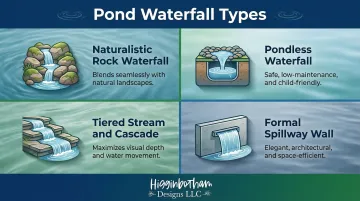
Formal Spillway Walls and Raised Pond Combinations
Modern designs use raised pond or planter walls with built-in spillway lips, typically constructed from concrete or natural stone coping. Water sheets off the edge in a smooth, controlled curtain into a lower basin. This style integrates seamlessly into contemporary patios and outdoor living spaces with clean geometric lines.
Inspiring Pond Waterfall Ideas by Garden Style
The best waterfall complements the existing character of your yard. A naturalistic woodland garden calls for a different treatment than a sleek patio with sharp angles.
Woodland and Cottage Garden Style
Use large mossy boulders, native ferns, and creeping plants around an informal cascade. Pair with koi or goldfish and marginal bog plants like Louisiana iris or pickerelweed—both thrive in Georgia's climate and stabilize pond edges naturally.
Golden canna (Canna flaccida) is a native perennial that's root-hardy in Zone 8a, adding vertical interest without invasive risk.
Modern and Minimalist Designs
Create clean-edge spillways using cut bluestone, slate, or premium hardscape coping that produces a smooth water curtain over a dark-tiled basin. Integrate directly into a patio or outdoor seating area for a clean visual flow between hardscape and water.
As a Belgard Authorized Contractor, Higginbotham Design can integrate premium hardscape materials—like natural stone coping and retaining wall systems—directly into spillway designs for a durable, cohesive result.
Tropical and Lush Garden Style
Combine a naturalistic waterfall with large-leafed tropical plants like elephant ears, cannas, and bamboo to create a resort-like atmosphere. Georgia's long growing season (220–230 frost-free days) means many tropical specimens stay in the ground year-round.
Caution: Elephant ears (Colocasia) spread profusely in wet areas and shade out native vegetation. Contain them in pots or designated zones. Similarly, horsetail (Equisetum) is listed on invasive species registries and requires aggressive containment.
Tiered Boulder Waterfall with LED Lighting
The same waterfall can function as both a daytime focal point and an evening feature. LED underwater and uplighting provides 90% energy savings over halogen alternatives and reveals the texture of water and stone after dark.
Low-profile 1-watt lights tucked below waterfalls capture movement without glare. Use 3000 Kelvin (warm white) for a natural look. When selecting fixtures, look for:
- 12-volt low-voltage operation
- IP68 rating (fully submersible)
- Corrosion-resistant housings for long-term durability
Dual Waterfall or Split Cascade Designs
Two separate waterfall channels feeding into one pond from different heights or angles create a more dynamic and layered soundscape. In wider garden spaces, a split cascade fills the space in a way a single channel can't — the overlapping water sounds create depth that carries across the yard.
Planning Your Garden Pond Waterfall
Planning before breaking ground separates a waterfall that thrives for decades from one that leaks, loses water, or needs expensive repairs. Focus on four core decisions.
Site Selection and Topography
A natural slope is an asset—gentle grades allow for more cascades, while flat yards require built-up earth mounds. Check the view from primary living areas (kitchen window, patio seating) to maximize enjoyment.
Key considerations:
- Keep waterfalls away from overhanging deciduous trees that drop heavy leaf loads
- Position for partial sun to discourage excessive algae growth in Georgia's warm summers
- Avoid planting trees on dams or levees—decaying roots cause seepage and structural failure
Size and Depth Decisions
Even a small pond (8×10 feet) can support a meaningful waterfall. For decorative-only ponds, 18 inches of depth is sufficient. For fish ponds in Georgia, UGA Extension recommends a minimum total depth of 5 feet over the majority of the pond area—enough to maintain a 3-foot survival buffer after drought-related water loss. Depth also matters for weed control: at least 3 feet of water shades the bottom and suppresses aggressive aquatic weed growth.
Style and Material Selection
Match the waterfall style to your home's architecture and garden design. Natural stone coping, boulders, and retaining wall systems give waterfalls an organic look, while cut-stone or concrete block options suit more structured, contemporary settings. Contractors certified through programs like Belgard's authorized installer network bring access to manufacturer-backed materials and warranties, which matters when hardscape elements are load-bearing or integrated with retaining structures.
Budget and Phasing
Plan the feature in phases rather than scaling back the core build. Pond and waterfall infrastructure needs to be done right the first time; lighting and plantings can come later without disrupting what's already in the ground.
Cost benchmarks:
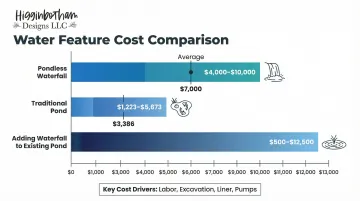
- Pondless waterfalls average $7,000 nationally, with most projects ranging from $4,000 to $10,000
- Traditional ponds average $3,386, with a typical range of $1,223 to $5,673
- Adding a waterfall to an existing pond costs $500 to $12,500 depending on design complexity
- Key cost drivers: labor, excavation, site accessibility, and materials (EPDM liner, pumps, boulders)
Understanding Spillways: Styles and Functions
Spillways are the control point where water leaves an upper basin or filter box and begins its drop. They're not just decorative—they regulate flow and sound.
Waterfall Box Spillways
A pre-formed waterfall box (or weir box) is a chamber connected to the pump and filter that releases water through a wide, even slot, creating a uniform sheet. Aquascape's 12-inch box handles up to 4,000 GPH; the 22-inch version handles up to 7,500 GPH. Flat capstones conceal the box cleanly, making this one of the more straightforward options for first-time pond builders.
Natural Stone and Custom Spillways
Use a single flat slab of bluestone, flagstone, or granite as a natural spillway lip, set at an angle over a rock face. This achieves a more organic, look that fits the exact setting. Shimming and sealing make or break the result—use expandable black waterfall foam sealant to fill gaps and force water over the stone rather than losing it underneath.
Blade Spillways for Modern Designs
Stainless steel or powder-coated blade spillways integrate into walls or raised planters, producing a thin, glassy sheet of water. 316 stainless steel is recommended over 304 for maximum durability and corrosion resistance. Key specs worth knowing before you spec a blade spillway:
- Supports up to 80 lbs per linear foot, so it installs directly into standard 4-inch masonry walls
- 316 steel resists salt and chlorine better than 304 — worth the premium for outdoor use
- Works with raised planters, retaining walls, and contemporary patio features
Essential Equipment for a Functioning Waterfall
Behind every beautiful waterfall is reliable infrastructure: a properly sized pump, quality liner, and appropriate filtration. Cutting corners on any one of them is the leading cause of waterfall shutdowns and leaks.
Pump Sizing
The pump must have sufficient GPH (gallons per hour) to push water to the top of the waterfall height. As a general rule, plan for 125 GPH per inch of waterfall width (or 1,500 GPH per foot). For a heavier, "whitewater" flow, calculate using 200 GPH per inch.
Size pumps on Total Dynamic Head (TDH), not the "0-foot" maximum rating shown on the box. TDH has two components:
- Static Head — the vertical rise from pump to waterfall top
- Friction Loss — add 1 foot of head loss per 10 feet of pipe run
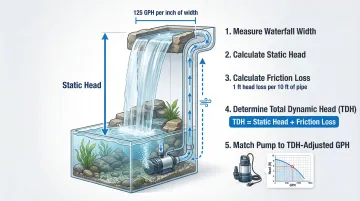
A pump rated at 3,000 GPH at zero head may only deliver 1,800 GPH at your actual TDH—enough difference to turn a dramatic cascade into a disappointing trickle.
An undersized pipe compounds this problem significantly—think trying to drink a thick milkshake through a cocktail straw.
Liner and Underlayment
The industry standard for residential ponds is a 45-mil (1.14 mm) EPDM synthetic rubber liner. It meets ASTM D7465 specifications, is UV-stable, and remains flexible in extreme temperatures.
Don't skip underlayment. Manufacturers require padded fabric underlayment to protect the liner from sharp rocks and roots—skipping it can void the 20-year warranty.
Filtration and Water Clarity
Effective algae control—especially relevant in Georgia's hot, humid summers—relies on three systems working together:
- Mechanical Filtration — Skimmers trap physical debris before it decays
- Biological Filtration — Filter media provides surface area for beneficial bacteria to convert toxic ammonia into nitrates
- UV Clarifiers — Ultraviolet light destroys the DNA of single-celled algae (green water), clumping them so mechanical filters can remove them

Ongoing Maintenance for a Beautiful Water Feature
Maintaining a pond waterfall in Georgia is straightforward once you follow a seasonal routine. A few targeted tasks each quarter keep the water clear, plants healthy, and equipment running reliably.
Seasonal Care in Georgia's Climate
Spring (32°F–55°F):
- Rinse rocks and remove accumulated debris
- Restart pump and check for leaks
- Add beneficial bacteria early to control nutrients before algae blooms
Summer (70°F+):
- Skim debris weekly
- Check water levels due to evaporation
- Monitor for algae; bacterial and enzymatic activity peaks in warm water
Fall:
- Install netting to catch leaves
- Trim back overgrown aquatic plants
- Reduce feeding if you have fish
Winter:
Georgia's mild winters rarely require full shutdown, though protecting pumps from occasional freezing nights is advisable.
Keeping Water Clear and Plants Balanced
Trim overgrown aquatic plants and divide bog plants annually. Beneficial bacteria products break down organic matter (fat, protein) and reduce ammonia—they're most effective above 50°F.
After adding bacteria, unplug the UV clarifier for 48 hours so colonies can settle and attach to filter media before the UV light cycles back on.
Partial shade plantings around the feature reduce algae pressure in Georgia's hot summers. Aquatic plants do double duty here—absorbing phosphates and pulling excess nutrients directly from the water.
Frequently Asked Questions
What is the difference between a pond waterfall and a spillway?
A spillway is the lip or outlet where water begins its drop, controlling flow rate and sound. A waterfall refers to the full flowing structure—rocks, elevation change, and basin. They work together as components of the same system.
Can I add a waterfall to my existing pond in Marietta, GA?
Yes, a waterfall can often be retrofitted by adding a pump, waterfall box, and built-up rock structure adjacent to the pond edge. A site assessment is recommended to evaluate existing liner integrity and proper pump sizing.
Do I need a permit to build a pond waterfall in Georgia?
Most residential garden ponds and waterfalls under certain depths don't require a permit in Georgia. However, land disturbances within 200 feet of perennial State Waters require an LDA permit, and Cobb County requires fencing around ponds deeper than 6 feet. Always call Georgia 811 before digging.
How much does a garden pond waterfall cost to install?
Costs vary widely based on size, materials, and complexity. Pondless waterfalls average $4,000–$10,000, while traditional ponds with waterfalls typically range from $1,200 to $5,700. Custom designs with premium hardscape materials will be at the higher end.
What pump size do I need for a pond waterfall?
Pump sizing depends on waterfall width and height. A general rule is 125 GPH per inch of width, adjusted for Total Dynamic Head. For accurate sizing that accounts for friction loss and elevation, consult a professional.
How do I keep my pond waterfall water clear?
Combine UV clarification (which disrupts algae reproduction) with biological filtration using beneficial bacteria to keep water balanced. Partial shading and aquatic plants further reduce algae load in Georgia's warm climate.
Ready to bring a custom pond waterfall to life in your Marietta garden? Higginbotham Design brings 35+ years of local experience, Belgard Authorized Contractor certification, and an A+ BBB rating to every project. Contact us at (770) 547-5524 for a free consultation and quote.